I have navigated community ecosystems since the era of BBSs and ARMA 2. This current shift feels different. We are witnessing a trend where the "boots on the ground" the people who actually feel the pulse of the crowd—are being replaced by synthetic mirrors.
The automation mirage
Community Management has long been a multi-disciplinary machine. A single person must be a diplomat, a writer, a crisis manager, and a technical specialist. Because these tasks are often seen as operational rather than strategic, they are the first to be fed into the AI maw.
But AI is a mirror, not a mentor. It can replicate the style of a patch note, but it cannot understand the intent behind a player’s frustration. An automated interaction is a hollow victory that trades long-term trust for short-term metrics.
The knowledge drought
In military history, you do not become a Staff Officer without first understanding the grit of the front line. The same applies here. Today’s seniors are effective because they spent years in the trenches of toxic subreddits and chaotic Discord launches. They developed a gut feeling for when a community is about to boil over.
If we stop hiring juniors, we create a catastrophic gap in the hierarchy:
- The Senior Surge: Current seniors are forced into high-level strategy, detached from the daily atmosphere of the player base.
- The Ghost Pipeline: In five years, we will lack new seniors. You cannot prompt-engineer ten years of human nuance.
- The Pattern Fatigue: Players are experts at spotting AI-behaviour. Once a community feels it is shouting into a digital void, the "tone-deaf" label becomes permanent.
We are currently burning our seed corn to stay warm for one winter.
The junior as an operational auditor
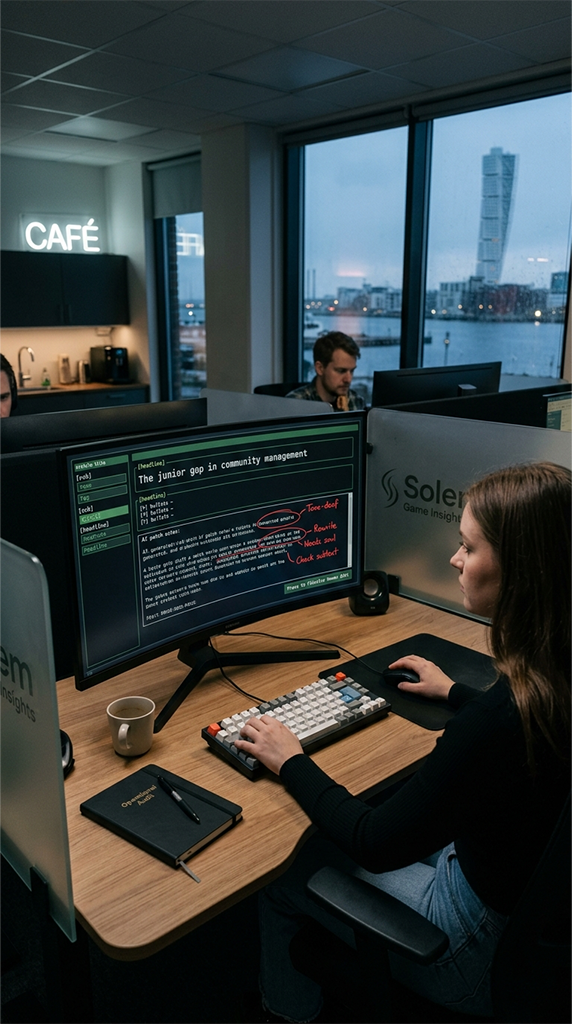
The solution is not to retreat into a "retro-future" nostalgia where we banish AI. That ship has sailed. Instead, we must redefine the Junior CM as an Operational Auditor.
However, we must be careful not to oversimplify this shift. A junior cannot simply "judge" the output of a machine without first mastering the craft itself. To effectively audit AI-generated content, a junior must still possess foundational editing skills, a sharp eye for subtext, and the ability to write a compelling narrative from scratch. You cannot spot a mechanical hallucination if you do not know what an authentic human voice sounds like.
Their labour involves directing the machine to handle volume while they provide the soul. This requires them to:
- Deconstruct AI drafts: They must have the technical literacy to edit and rewrite automated text until it loses its synthetic sheen.
- Act as the panic button: They must identify subtle shifts in sentiment that an AI would categorize as noise.
- Master the tools: They need to learn the limits of the software by pushing against them, failing, and correcting the course manually.
By pairing juniors with AI, we do not bypass the "grunt work" of learning to write or edit. Instead, we accelerate their exposure to high-stakes judgment calls.
An accountable future
Real community development is about being accountable for the emotional health of your players. If an AI fails to catch a brewing PR disaster, a senior executive in a meeting will not be the one to fix it.
We need a generation of CMs who leverage the speed of AI but retain the philosophical grounding of a veteran. We must stop looking at juniors as a cost to be cut. They are the necessary curators of our digital survival.
Technology can simulate a conversation, but only a human can build a home.